Search
Chain Wrench or Pipe Wrench? Understanding the Key Differences
Chain wrenches and pipe wrenches are both used to turn pipe and fittings, but they excel in different situations.
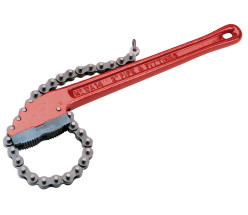
Chain wrenches use a link chain that wraps around the pipe. This encirclement provides multiple points of contact, allowing for even pressure and a strong grip. This matters on larger diameter pipe or pipe surfaces that are corroded, brittle, or uneven. Full wrap‑around contact reduces breakage risk. Because only the chain needs to fit around the pipe, a chain wrench performs well in tight or restricted spaces. Chain wrenches can switch direction from tightening to loosening without removing the tool from the pipe. They are commonly used for larger pipes and irregular shapes, though they typically take a bit more time to position and adjust.
Pipe wrenches use hardened teeth and an adjustable jaw tightened by a thumb screw. They are quick to set up and ideal for fast gripping of standard pipe sizes. Pipe wrenches are widely used for general plumbing and maintenance work, particularly where there is room to reposition the wrench during use. However, they are limited by jaw capacity and require clearance to swing the handle. Plus, pipe wrenches have to be removed from the pipe and then attached in the other direction to change from tightening to loosening.
REED offers exclusive Chain Wrench sizes to fit up to 18-inch (457 mm) diameter pipe capacity. The WA72 and WA84 are hefty tools designed to handle tough jobs that require maximum torque and full circumference grip to prevent point loading that could crack clay or concrete.
In the REED professional-grade Pipe Wrench line, find both cast ductile iron (RW) or heat-treated titanium aluminum (ARW) handles where choice is based on operator preference.
In summary:
Choose a chain wrench for maximum contact, better grip on large diameters, and work in restricted spaces.
Choose a pipe wrench for speed, convenience, and routine pipe work.
Chain Wrench vs. Pipe Wrench — Quick Comparison
| Feature | Chain Wrench | Pipe Wrench |
| Gripping method | Linked chain wraps completely around the pipe | Adjustable jaw with hardened teeth |
| Points of contact | Multiple points of contact around the full circumference | Limited to the jaw and teeth contact area |
| Pipe size range | Excellent for medium to large diameter and irregular pipe | Only covers small to medium diameter pipe |
| Adjustment | Chain length adjusted manually; a little slower setup | Quick adjustment using a thumb screw |
| Speed of use | Slower to position and tighten | Fast to grip and release |
| Tight space performance | Good—only the chain must fit around the pipe | Limited—requires room to fit the hook jaw and body of the wrench into place |
| Common applications | Large pipe, stuck fittings, demolition, certain pipe materials, maintenance work, water mains over 8 inches | General plumbing, installation, and repair |
| Limitations | A little slower setup and initial adjustment to pipe | Limited jaw capacity; fewer contact points |
| Best choice when… | Maximum grip and evenly distributed torque are required | Speed, convenience, and routine work matter most |